
How to Engineer AI Story Writing Prompts for Unforgettable Characters & Plots
Introduction: Beyond 'Write a Story' - Your Journey to Becoming a Prompt Architect
Ever typed "write a story about a dragon" into an AI, only to get a tale so bland it could put a caffeinated pixie to sleep? You know the one: a brave knight, a generic princess, and a fire-breathing beast with the personality of a toaster. It’s a common frustration, and it’s the reason many brilliant creators feel that AI-generated content lacks a soul.
As a narrative designer with over 15 years in the trenches of the creative industries, I've seen it all. And I'm here to tell you the problem isn’t the AI—it’s the prompt. The good news is that you have the power to change that. This guide is your first step to transforming your mindset from a passive 'prompt user,' who merely gives commands, to an active 'prompt architect,' who designs, engineers, and directs the AI with precision and creative intent.
We’ve moved far beyond the early days of simple, one-line commands. Today’s sophisticated language models are less like vending machines and more like incredibly talented, but very literal, apprentices. They need a master architect to give them a detailed blueprint. Without one, they’ll just build a generic box. With one, they can help you build a cathedral.
I learned this lesson the hard way. A few years ago, I was working on a personal world-building project for a sci-fi universe. My initial ideas were weak: "Describe a futuristic city," or "Create a character who is a space smuggler." The results were a mishmash of clichés—glittering metal skyscrapers and a Han Solo knockoff. Frustrated, I almost gave up. Instead, I changed my approach. I stopped telling the AI what to do and started teaching it how to think. I provided constraints, lore, character psychology, and tonal guidelines. The outcome was a breakthrough. The generic city became a bio-luminescent metropolis carved into a giant asteroid, and the smuggler turned into a disgraced xenobotanist selling rare alien plants. It was the moment I realized we don't just use prompts; we must design them.
Part 1: Architect's Mindset - Core Principles of Prompt Engineering for Fiction Writing
So, how do you craft a good prompt for a story? The secret isn't a magic formula, but a shift in mindset. Instead of giving the AI a vague suggestion, you're going to provide it with a professional-grade creative brief. We're moving from being a passive user to an active architect.
To build a truly powerful prompt, we can rely on five key pillars. I call it the C.R.T.C.P. framework:
- Context: The background information. The 'previously on' for your story. This includes lore, character backstories, and prior events.
- Role: Who the AI should be. Is it a witty playwright, a hardboiled detective novelist, or a world-weary poet?
- Task: The specific, actionable thing you want the AI to do. 'Write a scene,' 'create a character profile,' or 'brainstorm three plot twists.'
- Constraints: The rules of the game. This is where you define the tone, style, word count, and desired emotional impact.
- Persona: The personality and voice of the characters or narrator within the story itself.
Mastering these pillars is the first step to predictable, high-quality results.
The Impact of Context and Limits in Narrative Design
Imagine an AI’s focus as its context window—it's where it stores all the information you've given it for a specific task (Source). When you provide minimal context, you put a high cognitive load on the model. It has to make many assumptions about your world, characters, and plot, which is why its output often feels generic. It’s guessing what you want.
By providing deep context (the political history of your fantasy kingdom, the childhood trauma that drives your protagonist) and clear constraints (write in a minimalist style like Hemingway, the scene must end on a cliffhanger, the target word count is 400 words), you dramatically reduce that cognitive load. You’re replacing the AI’s assumptions with your creative decisions. This is the single most effective way to prevent the AI from sounding robotic and to guide it toward creating prose that is sharp, intentional, and aligned with your vision.
A powerful and enjoyable technique in prompt engineering is assigning an AI persona. Instead of telling it what to write, you tell it who it should be while writing. This simple shift influences everything from word choice and sentence structure to pacing and tone.
Compare:
- Vague: "Write a story about a space detective."
- With Persona: "You are an award-winning sci-fi author in the vein of Philip K. Dick, known for your gritty, philosophical prose. Write the opening scene of a story about a washed-up private eye on Mars."
The second prompt gives the AI a voice, style, and rich tradition to draw from. You're not just using a tool; you're collaborating with a specific type of co-author whose style can be defined on demand.
Part 2: Crafting a Masterclass on the Essentials of Storytelling
Next, we'll transition from theory into practical application. This session will focus on your training in creating prompts tailored to the core components of storytelling: characters, plots, and worldbuilding.
How to Write AI Prompts for Unforgettable Character Development
Great stories are about compelling characters, but a prompt like "create a character" will give you a shallow sketch. To get depth, you need to prompt for psychology, conflict, and motivation.
How to Craft a Master Prompt for Character Creation
- Start with the Core Archetype: Begin with a high-level concept (e.g., 'a cynical doctor,' 'an ambitious young knight').
- Layer the Internal Conflict: What is their primary internal struggle? What do they believe about themselves versus what is actually true?
- Define the Goal: What is their single most important tangible goal in the story?
- Introduce the Fear: What is their deepest fear, and how does it prevent them from achieving their goal?
- Establish Their Voice: Describe how they speak. Are they verbose, terse, witty, formal? Provide a sample line of dialogue.
Here are a few examples you can adapt:
The 'Moral Compass' Prompt
Task: Create a detailed character profile for a protagonist. Context: The story is a post-apocalyptic survival thriller. The character is the leader of a small group of survivors.
Character Details: I require a character who is fundamentally decent but is compelled to make increasingly questionable moral choices in order to safeguard their people. Outline their fundamental belief of morality, the specific event that initially prompted them to compromise it, and the internal dialogue they have with themselves regarding this issue. Illustrate their guilt, yet also their determination.
The 'Ghost of the Past' Prompt
Task: Construct a backstory for an antagonist. Context: The antagonist is a charismatic cult leader in a cyberpunk metropolis. Character Details: Do not merely make them evil. Create a sympathetic background that explains their motivations. Detail a specific betrayal or loss from their past that altered their worldview. What noble goal did they originally have, and how has it transformed into the villainous actions they undertake today? Frame this backstory as a tragedy.
A compelling plot is more than just a series of events; it's a chain of cause and effect leading to rising tension. By framing your prompts around classic storytelling structures, you can guide the AI to build narratives that feel satisfying and purposeful. Referencing frameworks like Freytag's Pyramid (Exposition, Rising Action, Climax, Falling Action, Dénouement) or The Hero's Journey gives the AI a proven blueprint for pacing and structure (Source).
For example, instead of asking for 'a plot twist,' ask for 'a moment of reversal in the rising action that reveals the mentor character was secretly working against the hero all along.'
Below is a table showing how a simple prompt can be engineered for different genres to produce wildly different results.
| Genre | Engineered Prompt for 'Create a conflict between two characters' |
|---|---|
| Fantasy | "You are a master fantasy storyteller. Generate a scene of rising action where a stoic dwarven warrior and a hot-headed elven mage, who are allies, come into conflict over a newly discovered magical artifact. The dwarf wants to destroy it, fearing its corrupting power, while the elf sees it as the only way to defeat the Dark Lord. The conflict must be rooted in their cultural differences and end with them going their separate ways." |
| Sci-Fi | "You are an author of hard science fiction. Craft a tense scene between the captain of a ship and its chief scientist. The argument revolves around the AI onboard, which is showing signs of true sentience. The captain views it as a malfunction that poses a threat to the mission, while the scientist argues it's a new life form requiring protection. The dialogue should be filled with technical jargon and philosophical debate." | | Romance | "You are a contemporary romance author. Write a scene of conflict between two lovers about to move in together. The argument seems to be about something small—like a piece of furniture—but is actually a manifestation of their deeper fears about commitment and losing individuality. The scene must end with emotional vulnerability, not anger." | | Thriller | "You are an author of best-selling thrillers. Create a sharp, fast-paced scene where two detectives on a serial killer case have a major conflict. One detective has found evidence implicating their commanding officer, but the other refuses to believe it, accusing their partner of paranoia. The conflict must raise the stakes and create a sense of professional and personal betrayal." |
Prompt Techniques for Immersive World-Building
World-building prompts allow your imagination to run wild, but they must be grounded by a request for consistency.
- For Magic Systems: "Create a magic system based on elemental runes. The system should have clear costs and limitations. For every powerful spell, describe the physical or mental toll it takes on the caster. Provide three examples spells, their effects, and their costs."
- For Future Tech: "Brainstorm five pieces of everyday technology in a solarpunk society. For each, describe what it is, how it is powered by renewable energy, and how it has changed a specific aspect of daily life (e.g., communication, food production, transportation)."
- For Political Structures: "Describe the political structure of a subterranean city inhabited by insectoid aliens. Explain their form of government (is it a hive mind, a council of elders, or a monarchy?), how laws are made, and how power is transferred. What is the main source of political tension in this society?"
Part 3: Advanced Techniques for Long-Form AI Storytelling
Once you've mastered the basics, it's time to tackle the biggest challenge in AI-generated fiction: maintaining consistency over a long-form project like a novel.
The Art of the Meta-Prompt: Using a 'Story Bible' for Consistency
An AI's context window is limited. It will eventually "forget" important details from earlier parts of your story. The solution is to create a "Story Bible"—a master prompt that you include with every subsequent request. This is a user-imposed strategy to keep the state of your narrative consistent.
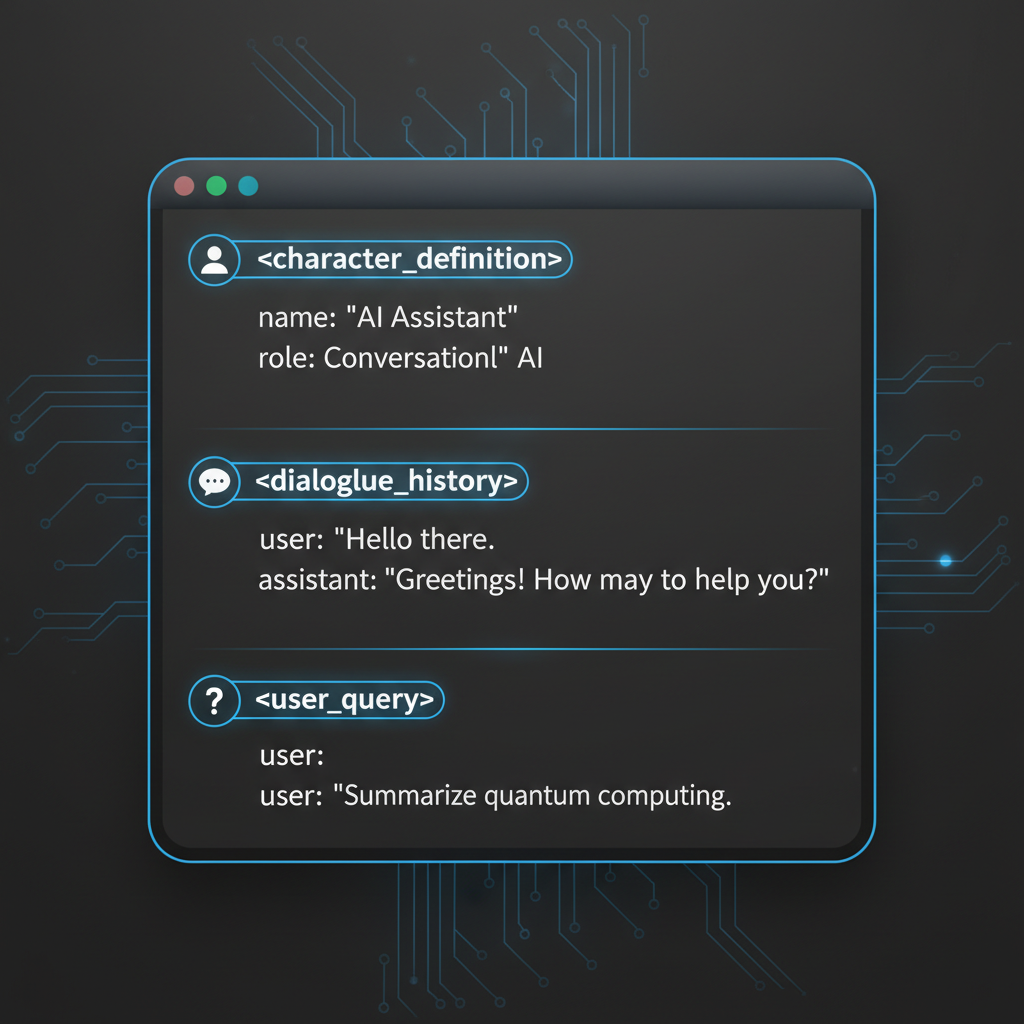
Your Story Bible should be a concise, bulleted document containing the unbreakable rules of your story:
- Main Characters: A one-sentence summary of each character's core motivation and personality.
- Key Plot Points: A summary of what has happened in the story so far.
- World Rules: The fundamental laws of your magic system, key facts about your world's history, etc.
- Tone & Style: A reminder of the desired writing style (e.g., 'Prose should be fast-paced and witty, in the style of Neil Gaiman.')
By placing this Story Bible above each new request, you continuously update the AI's knowledge, maintaining consistent character voices, respecting plot details, and adhering to the laws of your universe.
Chaining Prompts: A Workflow for Crafting a Complete Chapter
Do not attempt to write an entire chapter in one prompt. Instead, approach it as a director and divide the process into a series of smaller, more focused tasks. This allows you maximum control throughout each stage of the creative process.
Here’s a sample workflow:
- The Outline Prompt: "Create an outline for a scene where Character A confronts Character B about stolen data chips. The scene should consist of three parts: the accusation, denial and counter-accusation, and the revelation of crucial evidence. The scene must conclude with Character B fleeing."
- The First Draft Prompt: "Write a first draft based on the outline provided above. Focus on capturing the core action and dialogue. Do not worry about perfect prose yet."
- The Dialogue-Deepening Prompt: "Review the dialogue from the draft. Rewrite it to be sharper and more subtextual. Character A should sound more threatening, and Character B should appear more desperate. Incorporate more of their unique personalities into each line."
- The Prose-Refining Prompt: "Now, refine the entire scene. Enhance sensory details, improve pacing, and polish the prose. Ensure that descriptions of the environment reflect the escalating tension between characters."
Conclusion: Stop Guessing, Start Directing Your AI Co-Author
The transition from a basic prompt user to an advanced prompt architect is a significant step forward. We've moved beyond the hope of finding a 'perfect' prompt and into a world where intentional design plays a crucial role. The key takeaway is this: mastering AI for storytelling isn't about memorizing commands; it's about understanding communication methodology. It’s about learning how to provide context, define roles, set constraints, and shape the AI's persona to align with your creative vision.
You now have the blueprint to create narratives with precision and depth. By embracing the C.R.T.C.P. framework, leveraging a 'Story Bible' for consistency, and chaining prompts to construct complex scenes, you've shifted from being an operator to the director of your AI co-author. You are no longer guessing; you are engineering.
Your journey as a prompt architect has just begun. Take these techniques, experiment with them, and make them your own. Push the boundaries, combine strategies, and see what unforgettable worlds you can bring to life with the help of a powerful AI writing assistant. We’d love to see what you create—share your experiences and your most impressive results in the comments below. Let's build the future of storytelling together.
Abstract
This guide serves as a comprehensive masterclass for writers aiming to elevate their use of generative AI from a tool of convenience to a powerful creative partner. The core thesis is that by mastering the principles of prompt engineering, creators can move beyond generic outputs to produce nuanced, unforgettable narratives. We deconstruct the art of crafting prompts for core story elements—character, plot, and world-building—transforming them from simple commands into detailed architectural blueprints. The article introduces key methodologies, including the C.R.T.C.P. (Context, Role, Task, Constraints, Persona) framework for foundational prompt design. For long-form content, we explore advanced techniques such as using a 'Story Bible' meta-prompt to ensure narrative consistency and chaining prompts to systematically build complete chapters. Ultimately, this article equips you with the strategy to stop guessing and start engineering AI-assisted stories with precision, depth, and a unique voice.
References
To deepen your understanding of storytelling techniques and principles, this article draws upon foundational concepts from these seminal works on narrative design. We strongly recommend them for any serious writer's collection.
- Campbell, Joseph. The Hero with a Thousand Faces. New World Library, 2008.
- McKee, Robert. Story: Substance, Structure, Style, and the Principles of Screenwriting. ReganBooks, 1997.
- Snyder, Blake. Save the Cat! The Last Book on Screenwriting You'll Ever Need. Michael Wiese Productions, 2005.
- Aristotle. Poetics. Penguin Classics, 1996.
- Freytag, Gustav. Freytag's Technique of the Drama: An Exposition of Dramatic Composition and Art. Scott, Foresman and Company, 1900.
1. What are the top AI tools for creative writing?
Many options exist, but what works best varies based on individual needs. For raw creativity and flexibility, models like OpenAI's GPT-4 and Anthropic's Claude 3 family excel in generating prose, dialogue, and complex plots (Source). Specialized platforms tailored for authors include Sudowrite (Source) or Jasper, which offer features like character creation and plot organization alongside the core AI. The key is to find a tool that enhances your workflow and allows for deep, engineered prompts we've discussed in our guide.
2. How can I make my AI-generated story sound less robotic and more human?
This is the main challenge for any AI author. The solution lies in the techniques covered in this guide. Start by giving the AI a Persona. Instead of just a tool, treat it as your co-author ('You are a witty fantasy novelist in the style of Terry Pratchett'). Next, provide rich Context and Constraints, including emotional goals, subtext, and specific stylistic rules. Finally, use the AI's output as a first draft. The human touch comes in the editing—refining word choices, pacing, and adding those unique quirks that define your personal voice.
3. I'm facing creative writing blocks. How can AI-generated prompts assist?
AI serves as an endless brainstorming companion for writers. Instead of staring at a blank page, you can ask the AI to explore possibilities. Try prompts like: "Create five potential inciting incidents for a detective story set in a lunar colony" or "My character is trapped in a dungeon; give me three unconventional ways they could escape." This process isn't about letting the AI write for you; it's about generating ideas that you can build upon, effectively sparking your own creativity.
4. How do I balance my creative output with what the AI generates?
Think of the AI as a co-pilot, not the pilot. You are always the director of the story. The best workflow involves collaboration: you provide the vision and direction, while the AI handles rapid drafting, idea generation, and exploring different possibilities. Use the AI to handle the initial draft or brainstorm when stuck, but guide it with your unique ideas. Your creativity is expressed through your prompts, selection of the AI's best outputs, and final polish that weaves everything into a cohesive whole.